
 Executive Coaching Solutions understands the importance of being able to reach the right resource at the right time. Below are links that you may find helpful, useful and enlightening.
Also, be sure to check out our recommended books for your success.
Websites
- Harvard Business Review www.harvardbusinessonline.org; or www.hbr.org.
- Jacksonville Chamber of Commerce – www.myjaxchamber.com
- National African American Women’s Leadership Institute – www.naawli.org
- Women’s Businessowners of North Florida – www.jaxwbo.org
- Business Network International www.bni.com
- Business Women’s Network: www.bwni.com
- Training and Essential Resources for HR Professionals www.pfeiffer.com
- Executive Book Summaries www.summary.com
- First Coast Coaches Association www.firstcoastcoachesassociation.org
- International Coaching Federation www.coachesfederation/org/ICF
- Specialized Reference Sites www.refdesk.com

Emerging Topics and References
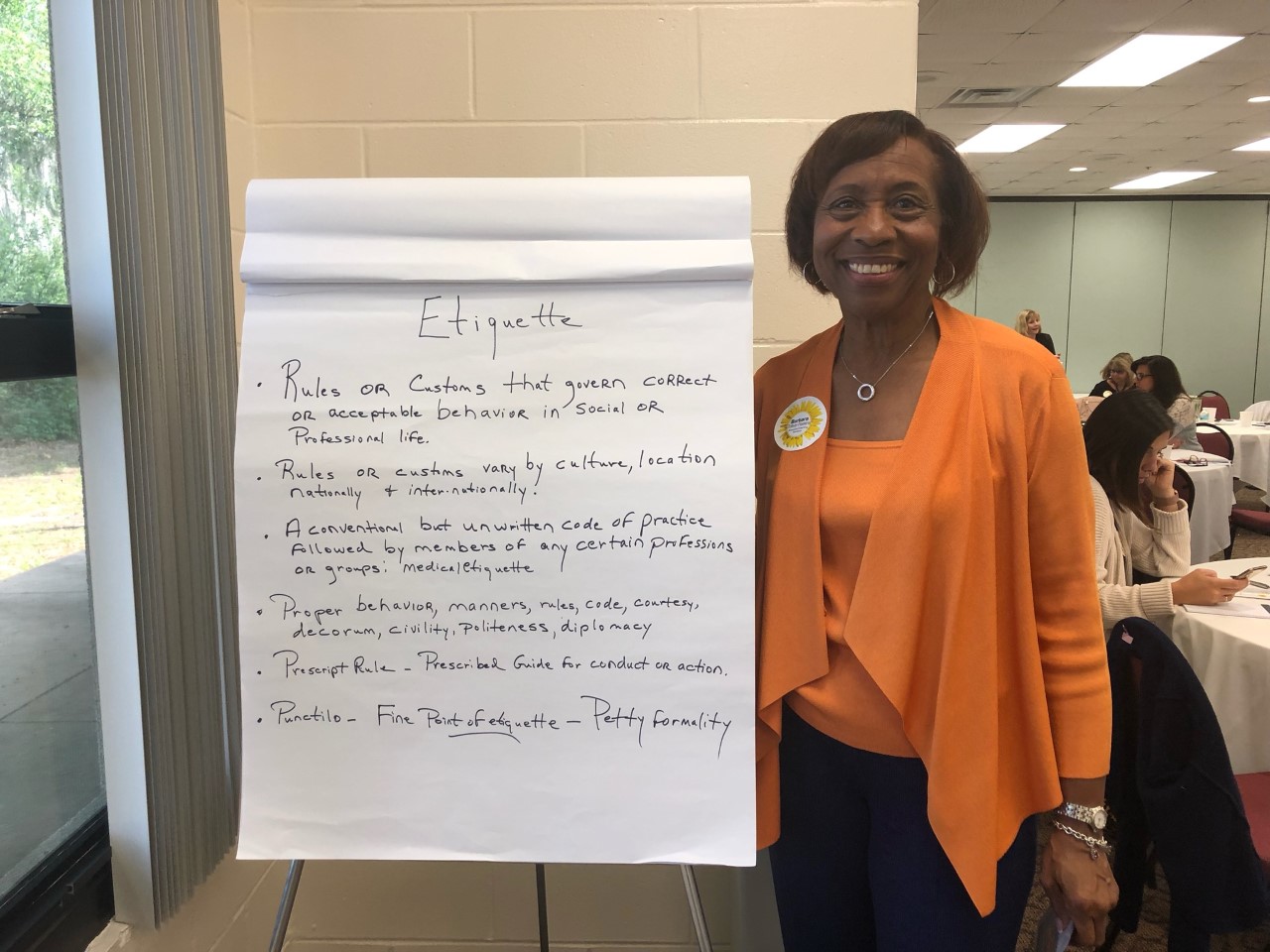
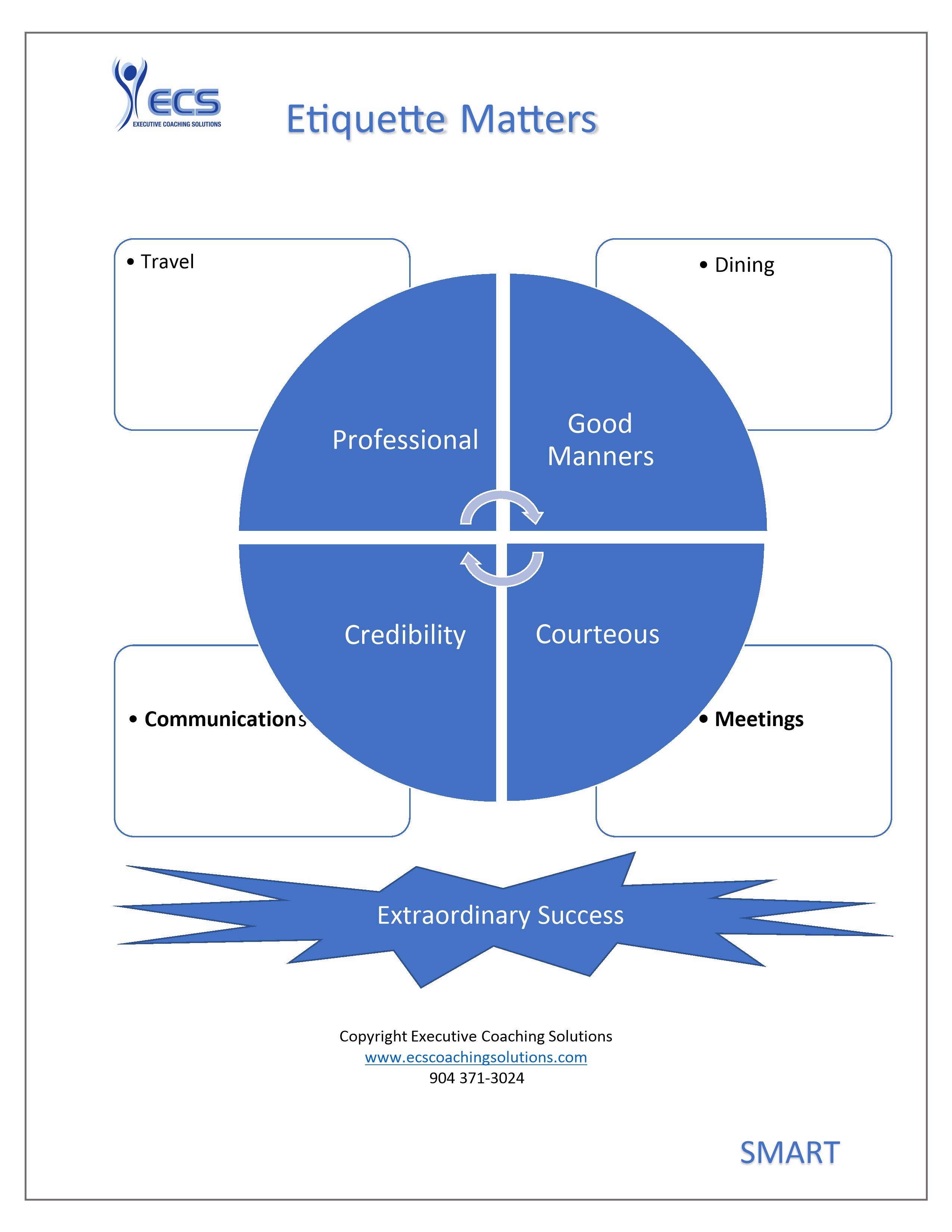
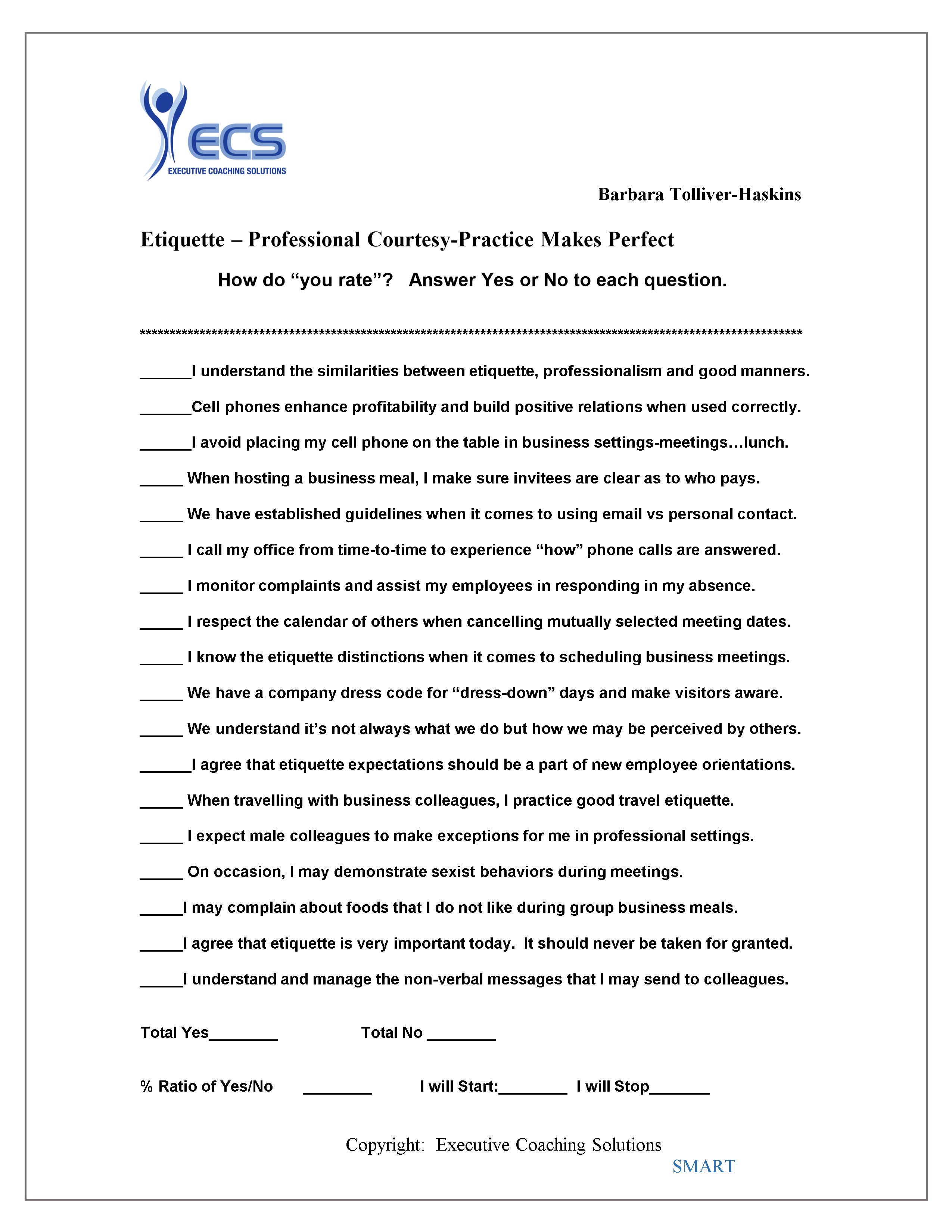
Real Estate Talk with Zelda. Barbara Tolliver-Haskins-Comments From a Coaching Perspective
Recommended Reading
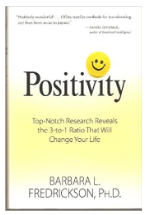
Positivity: Top-notch Research Reveals the 3 to 1 Ratio That Will
Change Your Life
Barbara Fredrickson, PH.D.
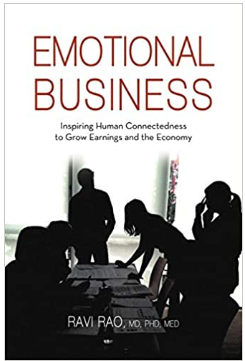
Emotional Business
If you’ve ever felt ignored as a customer, humiliated by a teammate, drained by workplace politics, or painfully isolated in a big company, then you’ve experienced the business effects of emotional disconnection. In today’s knowledge-driven and service centered economy, emotional excellence isn’t idealism. It is a practical necessity for growth and retaining superior talent. The Industrial Revolution is over, and the Emotional Revolution has now begun.
 The Power of Now
Eckhart Tolle
Tolle packs a lot of information and inspirational ideas into The Power of Now. (Topics include the source of Chi, enlightened relationships, creative use of the mind, impermanence, and the cycle of life.) Thankfully, he’s added markers that symbolize “break time.” This is when readers should close the book and mull over what they just read. As a result, The Power of Now reads like the highly acclaimed A Course in Miracles–a spiritual guidebook that has the potential to inspire just as many study groups and change just as many lives for the better.
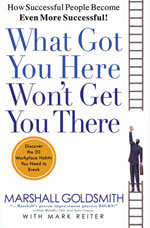 What Got You Here Won’t Get You There: How Successful People Become Even More Successful
Marshall Goldsmith with Mark Reiter
Goldsmith, an executive coach to the corporate elite, pinpoints 20 bad habits that stifle already successful careers as well as personal goals like succeeding in marriage or as a parent. Most are common behavioral problems, such as speaking when angry, which even the author is prone to do when dealing with a teenage daughter’s belly ring. Though Goldsmith deals with touchy-feely material more typical of a self-help book—such as learning to listen or letting go of the past—his approach to curing self-destructive behavior is much harder-edged. For instance, he does not suggest sensitivity training for those prone to voicing morale-deflating sarcasm. His advice is to stop doing it. To stimulate behavior change, he suggests imposing fines (e.g., $10 for each infraction), asserting that monetary penalties can yield results by lunchtime. While Goldsmith’s advice applies to everyone, the highly successful audience he targets may be the least likely to seek out his book without a direct order from someone higher up. As he points out, they are apt to attribute their success to their bad behavior. Still, that may allow the less successful to gain ground by improving their people skills first.
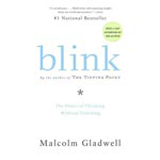 Blink: The Power of Thinking Without Thinking
Malcolm Gladwell
Blink is about the first two seconds of looking–the decisive glance that knows in an instant. Gladwell, the best-selling author of The Tipping Point, campaigns for snap judgments and mind reading with a gift for translating research into splendid storytelling. Building his case with scenes from a marriage, heart attack triage, speed dating, choking on the golf course, selling cars, and military maneuvers, he persuades readers to think small and focus on the meaning of “thin slices” of behavior. The key is to rely on our “adaptive unconscious”–a 24/7 mental valet–that provides us with instant and sophisticated information to warn of danger, read a stranger, or react to a new idea.
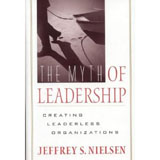 The Myth of Leadership: Creating Leaderless Organizations
Jeffrey S. Nielsen
When we join an organization, we’re immediately slotted into a hierarchy based on a rank-based system of “leaders” and “followers.” We then make false assumptions about our place in these hierarchies that divide our efforts, limit our growth opportunities, and rob us of meaningful, dignified work. These assumptions are what Jeffrey Nielsen calls the “myth of leadership.”
In this unconventional book, Nielsen calls for an end to “rank-based” organizational structures, which foster secrecy and miscommunciation, and steal the joy from work, while breeding corruption and abuse of power. Nielsen’s new model is the “peer-based” organization, which uses rotating peer leadership councils and cross-functional task forces to manage the organization’s work. These new entities are better suited to making decisions based on the organization’s competencies and customer needs, rather than on static functional groups or other artificial divisions.
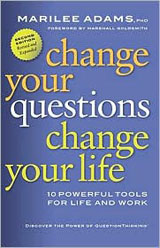 Change Your Questions, Change Your Life: 10 Powerful Tools for Life and Work
Marilee Adams, PhD
Questions are at the core of how we listen, behave, think, and relate–as individuals and organizations. Virtually everything we think and do is generated by questions. Questions push us into new territories. The future begins with our thinking, represented by the questions we ask ourselves.
“Change Your Questions, Change Your Life” shows readers how to consistently choose the questions that can lead them to success, both personally and professionally. The book is a personal growth fable that tells how a seasoned executive, Ben Knight, uses QuestionThinking to move into a higher leadership role and how the same methods of change help him and his wife, Grace, enrich their marriage.
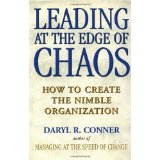 Leading at the Edge of Chaos: How to Create the Nimble Organization
Daryl R. Conner
Conner heads ODR, Inc., an Atlanta-based consulting firm. For 25 years, he has been a leading expert in the field of preparing for and implementing change. Flexibility is a requirement as he touts “nimbleness.” In an earlier book, Conner described the structure of change. He looked at how people respond to organizational transitions and suggested principles for managing the change process. Now he moves beyond the notion of change management to consider the problems faced in leading an organization during a period of turmoil. He addresses the key question of how to prepare individuals for changes that have yet to occur and that are still unknown. His answers are the “nimble organization” and “human due diligence.” Conner defines “nimbleness” as the ability to succeed consistently in unpredictable environments, and warns that it requires not just flexibility but “speed, grace, dexterity, and resourcefulness.” “Human due diligence” addresses the human element of change and refers to the “extensive and comprehensive investigation” required to lay the groundwork for change.
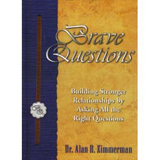 Brave Questions: Building stronger relationships by asking all the right questions
Dr. Alan R. Zimmerman
Communication can be magic, but it can also be maddening. It all depends on the skills you have.
This book will bring out the magic. Whether it is with your spouse, your kid, your friend, or your co-worker, almost any relationship can be strengthened. And the strengthening process taught in this book is simple, fun, safe, and effective. It really works!
You’ll learn how to ask Brave Questions that go beyond the mundane and the superficial. You’ll learn how to listen with respect and understanding. And you’ll have better conversations than you ever dreamed possible.
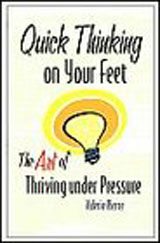 Quick Thinking on Your Feet: The Art of Thriving Under Pressure
Valerie Pierce
In Quick Thinking on Your Feet, you’ll learn how to clarify your thinking before you try to convince others, overcome the manipulations that others use to derail your arguments, and sell yourself and your ideas in any situation. Whether you want to change jobs, improve relationships, realize a dream, get that promotion, or control your wayward teenager, Quick Thinking on Your Feet helps you change the way you think about your objective, and more importantly, how you get others to think about it.
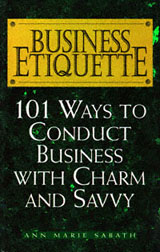 Business Etiquette: 101 Ways to Conduct Business with Charm and Savvy
Ann Marie Sabath
Ann Marie Sabath, the “Ms. Manners of the Midwest,” according to USA Today, offers to-the-point solutions to the most commonly asked business etiquette questions. She helps readers overcome moments of indecision, giving them the ability to function with the confidence that the impression they are making is a positive one. She helps us avoid that oh so embarrassing office faux pas, or unintentional inappropriate behavior, or appearance blunders that could lead to ridicule, social seclusion or even business disaster. This book thoroughly examines: the art of getting people to talk; proper attire; correct correspondence including rules about email; pleasing phone manners with tips about voicemail; dealing with decision-makers; handling social occasions and situations with ease and grace; international courtesy including the dos and taboos; and many business occasions where knowing the correct thing to do will pay off.